


























What Wire Does With All Those Electrons, or
Everything you ever didn't want to know about wire
and should probably have been afraid to ask.
The components in a home audio/video system are pretty complicated to anyone without a good understanding of electronics; but wire--good, old-fashioned wire--is something we can all understand. It's made out of metal, and it connects two things together so that electricity can flow between them. But what the heck is wire doing when it routes those electrons around, anyway? How does it work, and why does it matter?
Well, let's start by taking a look at electricity itself. Electricity is nothing but the flow of electrons through substances. Some substances are noted for being very good "conductors"--that is, they allow electrons to flow through them quite readily--and others are noted for being very good "insulators" because they are almost impervious to electric current. That's why the power lines near your house are metallic, but the insulators holding them away from the poles are glass, ceramic, and/or plastic. Electronics, to strip away all the complexity for a moment, is really the art and science of using conductors, insulators, and other, more exotic components like "semiconductors" to get electrons to do work, such as making sound or pictures, for us.
So, the simplest model for how electricity behaves in a wire is that wires act like pipes through which electrons flow like water. That model, however, doesn't really quite work, because electricity interacts with its surroundings in strange and interesting ways.
Most of the electricity with which we're concerned in dealing with home audio and video falls into the general category of "alternating current." That is, unlike a "direct current" which flows continuously in one direction, audio and video signals generally flow in both directions, alternating rapidly between one direction and the other. The rate at which these alternations occur is what we call "frequency," and it plays an important role in the behavior of signals in wire. Frequency is expressed in "Hertz," the number of complete cycles through positive and negative flow which occur in one second. Some alternating currents have a simple frequency--for example, household supply current in the U.S. runs at 60 Hertz--while others, like the signal representing a human voice, are very complex, with many frequencies laid over one another and changing constantly.
What's in a Wire?
The features of a wire which most affect a signal are resistance, capacitance and inductance. Let's look at these, one at a time:
Resistance: Although some materials are very good conductors and others are very good insulators, there's no such thing as either a perfect conductor or a perfect insulator. All materials have "resistance," which simply represents the opposition the material presents to the flow of current. When current flows through any material, no matter how conductive, some of the electrical energy is transformed into heat. This is why, for example, a lightweight extension cord can't safely be used to power a large air conditioner--the power demands of the air conditioner put so much electricity through the cord that it heats up greatly, the insulation softens, and a fire hazard is created. From an audio/video perspective, while it's better to have low resistance than high resistance, the good news is that resistance doesn't really, in itself, do much to distort signals; it just makes them a little weaker at the far end of the wire than they were when they went in, and absent unusually long wire lengths or other peculiar circumstances, that's not much of an issue.
Capacitance: One of the ways in which electricity does not resemble water flowing in a pipe is that electrical systems exhibit "capacitance." Imagine, if you will, that we take two sheets of aluminum foil and place a good insulator--say, a thin sheet of glass--between them. We then take a power cord, attach one of its leads to each piece of foil, and plug it in to the wall. No current should flow in this circuit, you'd think, because the pieces of foil can't touch each other--and without contact, there's nothing but an insulator to flow across, and electricity doesn't flow across insulators, right? In fact, what happens is downright strange. On each cycle of the alternating current, electrons will flow into one side of the foil, acting like they had someplace to go despite the fact that the foil's a dead end. When the voltage reverses, electrons will flow out of that piece of foil and into the other piece of foil; and this dance will repeat itself sixty times per second. A meter hooked up to the circuit will show that a current is flowing, despite the fact that, to look at it, you'd figure there was nothing for the electricity to do. This is capacitance, and we'll talk more about its implications for audio/video later.
Inductance: another important way in which electrical flow differs from the flow of water is in the characteristic we call "inductance." When electricity flows through a wire, it creates a magnetic field around the wire, and in the case of an alternating current, that magnetic field is constantly in flux, energizing and collapsing at high speed. This magnetic field, in turn, interacts with other magnetic and electrical fields, sometimes in profound ways, and presents opposition to the very electrical flows which create it. An extreme but instructive example of what inductance can do is a device we're all familiar with: the power transformer. A transformer uses inductance to change electricity from one voltage to another, and like capacitance, acts in a surprising way. If you were to peel the cover off of a small power transformer, you'd find an iron core with a large amount of insulated wire wound around it. Let's say you follow the live wire from the wall into the transformer to see where it goes---guess what? It goes into the transformer, goes around and around the core perhaps several hundred times, and then goes right back to the neutral wire in the wall. Where the capacitor in our last example appeared to be an open circuit, but current flowed regardless of the fact that it was open, the transformer appears to create a short circuit, and you might expect it to blow the circuit breaker...but, of course, it doesn't. Taking the transformer apart, you will have noticed that there were other wires wound around it, but which were not connected to the wires coming from the walls. What actually happens in the transformer is that the flow of current in the wire that's plugged into the wall sets up a powerful magnetic field, and that magnetic field, in turn, "induces" a current to flow in the other windings, producing a different voltage in those windings. (Incidentally, a transformer doesn't, as many people think, turn AC into DC; that's done by a "rectifier," something which is outside the scope of our present discussion).
Every conductor exhibits inductance; a tight coil wound around an iron core displays a lot of inductance, but even a half-inch length of straight wire has inductance, too; every electrical flow, no matter how small, sets up a magnetic field around itself, and this inductive property is important in a couple of different ways, as we'll discuss.
Not Exactly a Pipe
So, capacitance exists everywhere that two wires, though not in contact with one another, are close enough to interact. Inductance, meanwhile, exists everywhere that current flows through a conductor. Any length of cable, then, exhibits both of these qualities: capacitance, because the wires are close together and separated by an insulator, and inductance, because the wires have length.
When thinking about a wire as essentially a pipe that routes electrons from one point to another, we might have drawn a simple circuit diagram--representing, say, a single audio channel running from your CD player to your receiver or amplifier--showing the relationship like this:
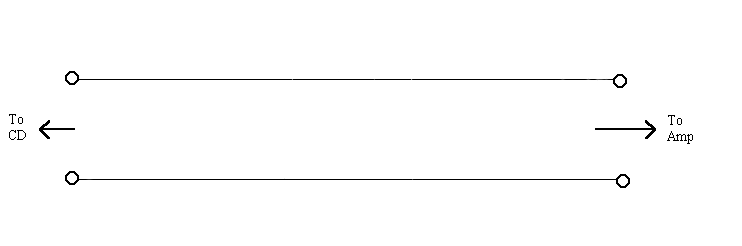
But taking into account the capacitance and inductance, we would be more accurate to show it like so (as you probably can guess, just from looking at the shapes, the components marked "L" represent inductors while the component marked "C" represents a capacitor):
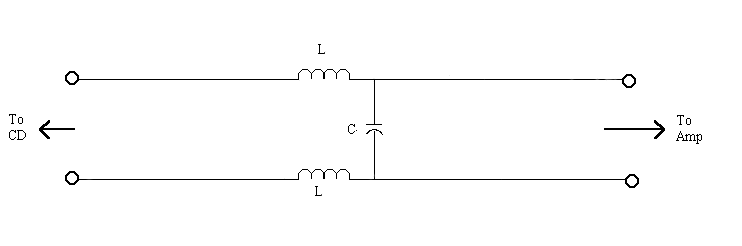
The electricity doesn't flow nice and straight from the CD player to the amp. Instead, it's interrupted, and altered, by the inductive properties of the wire, and some of its flow is absorbed by the capacitive properties of the wire. But the real relationship is more complicated than what's shown above; each segment of wire can be treated as having its own local capacitance and inductance, so that the true behavior of the cable is better modeled by showing an infinite number of very small capacitors between the lines, together with an infinite number of very small inductors along them:
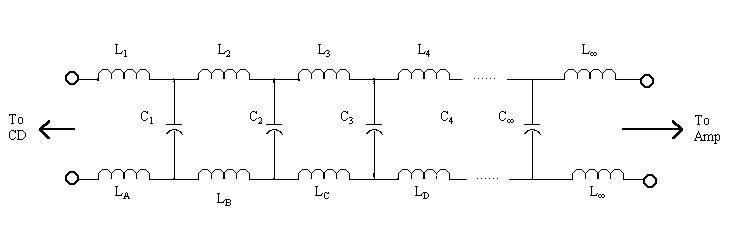
The point to be made here is that while we tend to think of the conductors in a cable as simply connecting one point to another, the fact is that a cable is itself a rather complicated, dynamic environment in which electrons are not just obediently hustling along to their destinations, but are getting into a little mischief along the way. But now that we've been dealing in the infinite, let's get back, as an electron would say, to ground. What does all of this MEAN to the performance of a cable in an audio/video system? Well, the answer is that capacitance and inductance react differently to electrical currents at different frequencies, and that these differences have a very real ability to affect what we see and hear. Let's start by taking a look at capacitance.
Remember our two pieces of foil separated by an insulator? Let's say that we ask a friend at the power company to turn up the frequency of the 60 Hertz power coming into the house for a while, and at the risk of his job, he obliges us. If we're watching a current meter to see how much electricity is flowing into and out of our homemade capacitor, as the frequency of the AC power increases, what we'll see is that the higher the frequency goes, the more current flows through our meter. Capacitance doesn't respond to all frequencies equally.
So, let's say that instead of a single waveform from the power company, where our friend has by now lost his job, we feed across the capacitor an audio signal of a singer's voice. What we'll see is that the high frequencies in our singer's voice result in more flow across the capacitor than do the low frequencies. Why does this matter? Well, let's now say that we run wires from the two sides of the capacitor to a speaker. What we'll hear in the speaker will not be quite the same as what came out of the source; instead, we'll hear a voice that has lost some of its high frequencies--because they're being shunted across the capacitor and aren't making it to the speaker--but has not lost a proportional amount of its low frequencies.
Now, bearing in mind that every cable exhibits some capacitance, and therefore behaves a bit like our makeshift capacitor, it's evident why you would want to minimize capacitance in a cable. How do we minimize capacitance? Basically, there's no mystery to it. We want well-made cable, with a good insulator (or, as the inner insulator in a coaxial cable or in a capacitor is often called, a "dielectric") of a type, such as polyethylene, which has the effect of minimizing capacitance. We need good connectors, since connectors also contribute capacitance to a cable; and, because the capacitance of any run of cable increases with length, we want the cable not to be unnecessarily long.
Inductance does somewhat the same thing to the audio signal, but through different means. The magnetic field set up by inductance resists changes in current flow--and an alternating current signal is constantly changing. Further, inductance doesn't resist all current flow changes equally; the higher the frequency, the more the inductor impedes the flow. If we took the aluminum-foil capacitor out of the circuit we discussed above, but then inserted a big coil inductor in the line to the speaker, we'd see the same type of effect: loss of performance at higher frequencies. Fortunately, inductance isn't a big factor at audio frequencies with normal conductor lengths; however, as we increase frequency it becomes more and more significant. Video signals, whether composite, component, or S-Video, all run at much higher frequencies, and TV signals running from a radio-frequency source--such as the signal coming in through an antenna or a TV cable hookup--run at still higher frequencies. In fact, the terms "VHF" and "UHF" stand for just that--"Very High Frequency" and "Ultra-High Frequency."
So, what can we do to limit inductance? The main factor here is conductor length. We want cables not to be unreasonably long; in an ideal world, they'd all be just long enough to reach, without any physical strain upon the cable, from one jack to the other. Of course, allowance should be made for ordinary movement of equipment, especially if your equipment is situated so that you need to pull devices out in order to access their jacks; the last thing you want to do is to make cables too short, and then damage them by pulling on them. If you have a setup where you have direct access to the back of your equipment, then it's much easier to minimize cable length. My personal perspective on this is that while it's good to have short cables, no perceptible performance enhancement will result from shortening a run of cable by a foot or two. Apart from conductor length, the other considerations in limiting inductance are--you guessed it--well-made cable and connectors.
Capacitance and inductance, acting together, can have strange and dramatic effects upon sound, and in some applications these effects are very useful. Capacitors and inductors are used in audio "filters" in communications radio precisely because of their impacts upon different frequencies. For example, in a shortwave receiver, it may be desirable to sacrifice high-fidelity performance so that a news announcer's voice can be clearly heard from a faint, distant station and the sound of adjacent stations can be excluded. Lousy fidelity, but good communications--and it's done with capacitors and inductors. In home audio and video, we're trying to avoid doing by accident what a shortwave radio designer might do on purpose.
A term you'll see used again and again with cables is "impedance matching." Basically, an "impedance matched" cable is one where the characteristic impedance (which is a function of capacitance and inductance) of the cable is compatible with the impedances of the source of the signal and the load the signal will drive--for example, your DVD player and your display. Impedance matching ensures that the signal is delivered efficiently to the load; this isn't really a factor at audio frequencies, and in fact most audio systems aren't impedance-matched to begin with, but at video frequencies, impedance matching becomes important, as mismatched impedances can cause portions of the signal to be reflected back and forth within the cable, resulting in ghosting or "ringing" of the image. In high-power, high-frequency applications like a transmitter at a broadcast station, impedance matching is very, very important; a bad impedance match can reflect so much excess power back into a transmitter that it can actually burn the transmitter out.
Outside Influences
So, a good cable has reasonably low resistance, to prevent meaningful signal loss; it has low capacitance and inductance, to prevent high-frequency loss; and it's impedance matched (if designed for an impedance-matched application), to do the best job of delivering the signal to its destination. But those aren't all the bullets the signal has to dodge. Electrons and their associated magnetic fields are everywhere, and part of the job a cable has to perform is to isolate the signal it carries from these outside influences.
Insulation, of course, is the first line of defense. Any cable is covered with a good insulator that keeps it from losing signal to other wires and objects it might happen to touch. The problem, however, is that an insulator only protects a wire from making a conductive contact with other sources of signal and noise, but can't stop the wire from interacting, capacitively or inductively, with all those other electrons out there.
The best way to understand the problem, perhaps, is to think about radio. When a radio transmitter blasts 50,000 watts of power into the sky, that power travels everywhere in a pulsating wave of electromagnetic energy. How does it get into your radio so that you can hear it? Inductance is the answer. Your antenna and your radio's internal circuitry are designed to resonate at or near the frequency of the transmitting station, so that the signal can be amplified, detected, amplified further, and transformed into something audible. This activity doesn't rely upon good electrical contact--the air that separates your antenna from the radio station is an excellent insulator, and there might be miles of it in between the transmitter and receiver. The electromagnetic waves in the air "induce" a very small current in your antenna, and your radio does the rest. But electrons, of course, are dumb; they don't just go after antennas, but interact with everything around, whether they're welcome or not.
If the problem were only radio signals, then only those of us who happen to live very close to radio transmitters would have to worry about outside electromagnetic waves getting into our audio/video gear. In fact, however, many sources give off electromagnetic energy. You've probably had the experience of hearing a car engine on the radio; that's because every spark emitted by a sparkplug releases a burst of electromagnetic waves. You've probably had the experience of hearing a radio click and hum when a fluorescent light was turned on; fluorescent lights, too, emit electromagnetic waves. What's more, every device, and every cable, in your home audio/video system emits its own electromagnetic waves. Your VCR can interfere with your DVD player, and vice versa. Your refrigerator probably gives off an electrical "click" every time it turns on...and so on, and so on.
The problem, of course, is keeping all of this stuff out. The answer to this problem is shielding. Generally, an audio or video interconnect jack has an inner connector and an outer, circular connector--and the outer connector generally is grounded to the chassis of the device. A coaxial cable, instead of running its two conductors side by side like a power cord, has an outside conductor and an inside conductor, and the outside conductor is called the "shield" because it shields the inner conductor from the influence of outside electromagnetic energy. Ideally, what happens is that radio energy and noise encounter the shield, discharge their energy to ground through the braid, and never reach the inside conductor which is carrying the signal; the noise is never heard from again. For all manner of reasons, in practice it doesn't always work quite this perfectly, but well-shielded cable is marvelous protection against noise. If a cable deals well with capacitance, inductance, attenuation, impedance matching, and shielding, it'll do right by your ears and eyes.
Moderation in All Things
It's well, when thinking about the ideal electrical characteristics of cable, to bear in mind that the best cable is sometimes a compromise between many electrical and non-electrical values. For example, we could make cables with lower capacitance by getting the conductors very far away from one another, but that would eliminate the possibility of shielding; we could use extremely thick coaxial cable, but we would suffer a terrible loss of flexibility without substantial performance gain. We could use more conductive materials at the cost of conductor strength and durability; and so on, and so on.
The good news, for those of us who don't really want to worry about the fickle motives of wayward electrons or the brittleness of a particular conductor material, is that there are electrical engineers who do nothing all day but study wire and work on how to make it better and better. The top cable manufacturers today make some extraordinary high-quality products, which only get better year after year. We can do our eyes and ears a favor by putting these products to work in our own living rooms.